skip to main |
skip to sidebar
Syria revisitedOctober 2006It was seven years since I last visited Syria, so I was interested to see how things might have changed in the interim in view of the upheavals in the region and the inexorable advance of Islamic fundamentalism.Differences in experience were apparent from the time the plane landed at Damascus airport at 2 a.m. When I arrived in 1998 accompanied by our dog, Simon, and two cats, official oil smoothed the whole immigration procedure and I was whisked through painlessly (See http://marysyria.blogspot.com/ The Road to Damascus posted under August 2005). This time I followed normal procedure like everyone else. However, the modernisation of the airport installations and greater organisation made this a less formidable task than it might have been seven years ago. There is a clearly signposted desk where visa payments must be made before proceeding through immigration. The worst part of that experience was trying to avoid being sent to the back of the queue by all the impertinent men, mostly Iraqi, who seemed to believe that it is their God-given right to stand at the head of the queue come what may, particularly if the person already there is a a women. This jolted my extremely rusty Arabic into action to assert my rights as first in the queue. I don’t know whether it was the surprise of having a fair-skinned woman utter any words at all in Arabic or the fact that a woman of any description would dare to defend her position. Anyhow, it worked. Fortunately immigration procedure was not too lengthy as at that ungodly hour nobody feels too inclined to stand in long queues for any longer than necessary. My visa invitation letter was satisfactory and I was allowed to pass through. The luggage was already unloaded so there was no waiting there. Robert was waiting for me the in the arrivals hall and we went straight to the house.Sleep was shortly interrupted. At 4 a.m. the nearby mosque set up its raucous call to Friday morning prayers which lasted for a long time. The mosque is a small one but it certainly has a powerful loudspeaker system! Damascus revisitedThe first day of my visit was spent revisiting the haunts that I had frequented during my previous stay – Malki, Abou Roumaneh, the now rapidly expanding residential district of Dumar, Mezzeh, a drive up Mount Qassioun followed by lunch at Gemini in the heart of the city. Reproachful eyes looked at the non-Moslem diners through the windows of the restaurant. As darkness falls early, around 5p.m., we returned home. The house Robert is renting is a fairly new building near the Mohajrin Hospital area. It is a rather uninviting neighbourhood which we had never liked when we lived there before so I cannot imagine what possessed him to rent there. The area around the hospitals was always teeming with people, particularly mothers with small children and many people squatting on the pavements outside. It has not changed much although there were fewer people on the streets perhaps due to the fact that it was ramadan. The apartment 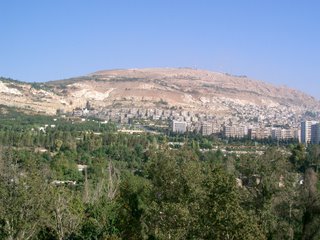 is furnished with the overstuffed seats beloved, it would appear, in all Middle Eastern and Arab countries. So two burgundy chaise longues and several chairs provide the wholly uncomfortable seating. Opposite the house is a patch of spare ground with rubbish containers. The denizens of the district are mostly conservative and the most attractive feature of the place are the cats who have become used to being fed from time to time. The cats in Damascus are not the lean-faced Egyptian variety but have round faces recalling the conformation of Persian cats. With the start of Eid the cats' existence was to find a new menace. The most popular Eid gift for boys this year seems to be a laser gun (In previous years I recall air guns and guns with powder crackers being all the rage) and the cats were the chosen target for persecution. The other saving grace is the view from the sitting-room window which faces in the opposite direction (east) and provides an open aspect of Mount Qassioun and the presidential palace.On Saturday morning we got up at 6a.m. – no sacrifice as day dawns early here – and drove up to Mount Qassioun for an early morning walk. Robert has a 6km. circuit which took us one hour to complete. The mountain is much as it was before, with its roadside cafés which, even at this early hour of the day, were playing music to attract the last lingering ramadan revellers. Some cars were parked with couples in them, which might seem surprising as most of the girls were “covered”. So how do they justify being out all night? Others were being driven fast and noisily by groups of young men. The other feature which has not changed is the rubbish. It is still lying thick on the ground and grew ever more abundant over the course of the next few days as more and more people spent time on the mountain consuming large quantities of pizzas and other foods with throwaway wrappers during the celebration of Eid al-fitr which closes ramadan. The feral dogs forage for food in the early morning when human presence is at its lowest ebb and one dog which is kept as a guard spends its entire life tied up in a cave opposite one of the pavement restaurants.Deir Mar Musa: http://www.deirmarmusa.org/After breakfast we set off for Deir Mar Musa some 81 km. north of Damascus. This is a place that I had not visited before. Deir Mar Musa is a monastery set high in the rock face in the desert. The monastery was founded in the sixth century A.D. by Mar Musa (St. Moses), an Ethiopian saint revered in the Syrian rite. The early monastic community lived in caves in the hillside and the small church with frescoes dating from around the 7th century has been restored due to the efforts of an Italian Jesuit priest, Padre Paolo, who has revived the site. There are now six monks and two nuns although both nuns are currently studying sociology in Italy. There is now a residential wing reached by a hanging bridge where people may spent the night or take part in retreats.The usual silence of the place was being raucously interrupted by the shouts of the workmen engaged in expanding the residential quarters. All the building materials and other day to day supplies are hoisted up to the the monastery by means of a kind of rope lift. The monks were busy preparing for the onset of winter, cleaning and polishing stoves. There is no question that winter in this unforgiving environment must be harsh indeed. The view over the desert from the little terrace is breathtaking and I should love to return one day when the building work is completed to enjoy the silence and perhaps even spend a night there.While we were there a TV crew was filming in the little church.The monks received us kindly and served us tea.Ma’alula revisted (See http:marysyria.blogspot.com Ma’alula posted under September 2005)Leaving Deir Mar Musa we set off for Ma’alula, the Christian village where Aramaic is still spoken which we often used to visit. We returned to the cavern of Mar Taqla and walked through the spectacular defile. Things are much the same, although a large new mosque has been built at the entrance to the village. This would seem to follow the pattern evident throughout the country where mosques are proliferating at a tremendous rate. We had arranged to meet Shaam, her husband Tarafa and baby daughter Leana at 5 o’clock in the Sahara restaurant for iftar, the meal which breaks the fast at sunset. It was a pleasant interlude and a chance to catch up on events in their lives.Sunday is a normal working day so Robert left me at the Méridien Hotel on his way to work. From there I walked to the Souq al-Hamidiyeh and the Ommeyad Mosque (See: http://marysyria.blogspot.com/ The Great Mosque of the Ummeyads posted under December 2005) where I had hoped to take some photos of the mosaics for Annabel, my art teacher. However, the mosque did not open to the public till 10 a.m. so I did not wait. One thing drew my attention and that is that the souq and surrounding area seemed cleaner than before (at least at that early hour) and a Kärcher machine was being used to sweep the streets. Could it be that the president’s medical background is having an impact on municipal cleansing policy?As I walked to the souq I counted the number of women not wearing the hijab. Only three! On the return journey and as I sat having coffee at the hotel and looking out the picture windows, I counted nine. This is surely a turnaround from seven years ago. To be sure mujhabat, or “cover ladies” as they were called, did abound but never to that extent. Also there were many more women wearing face veils and gloves. Not an encouraging sign for women’s rights by any stretch of the imagination! Many more men wearing the “fundamentalist uniform” of half-mast gowns are also to be seen on the streets.After having coffee with Shaam, Robert and I went in search of a very good bookshop that I used to frequent where they sold books on a huge variety of topics, including orthodox christianity. Unfortunately the shop is now closed and building work was going on inside. A shame. I had hoped to find some interesting reading matter there.
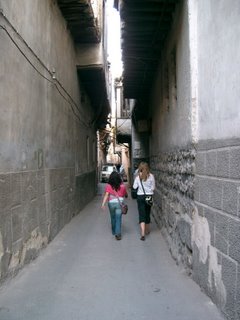 After that we went to Bab Touma, or the Gate of (St.) Thomas. This is the heart of the Christian area of Damascus (See http://marysyria.blogspot.com/ The Street called Straight posted under September 2005). As we ate lunch at Steed, it was interesting to feel the difference in atmosphere in this part of town. There were even people out walking their dogs, a site which would be unthinkable in the rest of the city. After lunch we went to Bab Sharqi, the Eastern Gate which marks the entrance to the old Roman city. This is also the Christian district of the old city. A poster announced a tantalising concert of ancient religious music in the Syriac rite but, unfortunately, it was to be held on the Sunday evening when I would already have left. A disappointment.Palmyra See http://marysyria.blogspot.com/ The Ruin Fields of Palmyra posted under September 2005) Eid was scheduled to begin on Monday, October 23rd. We had made a reservation at the Tetrapylon Hotel in Tadmor, the village next to Palmyra, and set off after an early morning walk on Mount Qassioun. However, when we arrived in Palmyra and Robert called George for more specific instructions about how to find the hotel, he was informed that Eid had been postponed till the following day because the imam charged with the task had not sighted the new moon. A problem, because this meant that Robert should actually have been at work. However, a few more phone calls resolved that issue and we could continue with our programme.The point which arises is how can it be that in the twenty-first century the use of a telescope or astronomical calculations are inadmissible in the declaration of a holiday? Only the visual sighting of the new moon is acceptable. The Syrian imam responsible for the sighting did not see the new moon on the evening of the 22nd., so Eid was postponed. In Saudi Arabia, France, Egypt and, it would appear, most other places, however, the moon was sighted so Eid began on Monday as planned. How can a country make progress when such a simple thing becomes an issue?In the end we opted to stay at the Heliopolis Hotel where the rooms were more ample and had a view over the oasis and the ruins of Palmyra. We had lunch at an open-air restaurant near the Zenobia Hotel. For a small plate of mezzeh we were charged the astronomical sum of 800 Syrian pounds or €12. On the subject of hotels, I still believe that, although the Zenobia may be a bit run down, no other hotel can match its location overlooking the ruins of Palmyra and right next door to the beautiful little temple of Baal-Shaman. When you stay there you are hardly aware of the existence of the modern village.In the afternoon we visited the spectacular ruins of Palmyra once again. The bedouin are encroaching on the site and a hippodrome has been built in the vicinity, all of which bodes ill for the ruin fields. The ever-increasing bedouin presence would appear to form part of some “colonising” plan as they proliferate everywhere. And proliferate they do with their huge families. One such tried to entice Robert to buy a necklace for me. He insisted that he needed the money to buy gifts for Eid for his seven children! What would the price of the necklace have been, I wonder?! To give him his due he did laugh at his own “sales patter” when he realised that we were no strangers to the region.Then we drove up to Qala’at Ibn Musa, the Arab citadel which perches on the cliff on the far side of the ruin fields. The inside of the citadel has been “restored” and an official desk selling tickets now stands at the entrance where Mohammed sat with this kuffiyeh when we last visited. Signs of the times.EidNot much sleep was had that night. At 2 a.m. the mosques began their call to prayer announcing the arrival of Eid. Allahu Akhbar x 3Short pause YallahThen the faithful repeated the same incantation. Next phase.Allahu Akhbar x2Short pause. Ila al Haqq.Once again this was repeated by the faithful.And so it went on from 2 a.am.till 7 a.m. Variety is evidently not the spice of life here.At 7 o’clock we left the hotel to climb up to the citadel in the cool of the morning. Once there, I tried to sketch the panorama looking down over the Valley of Tombs and the ridge beyond. Far from the village the desert casts its spell.After breakfast on the fifth floor restaurant of the hotel we opted to return to Damascus. It began to rain so the decision was a wise one. In the afternoon we went to the Sham City Center, a shopping centre which has sprung up since my previous stay in the country. As evening fell, thunder claps announced an approaching storm.Wedneday began once again with an early morning walk on Mount Qassioun. After that we headed south towards the Hauran and Izra’a, another village that we used to visit when I was here before.Izra’a (See http://marysyria.blogspot.com/ Izraa posted under December 2005)Our first stop in Izra’a was the home of Abu and Um Yusuf. Abu Yusuf was the Greek Orthodox priest at the Church of St. George. He is now retired and unfortunately we found him walking with the aid of crutches as he had injured his hip in a fall a year earlier in Beirut. Like many people who suffer such falls, he had succumbed to the idea that the only thing to do was sit around with the result that healing was slow. He was pleased to see us and we ate some fruit with him and his wife before setting off to some excavations which are being down just down the street.Then we visited the church once again. The church at Izra’a, which dates from the around 630 A.D. is the longest continuously used Christian church in Syria. It is remarkable as one of the earliest examples of a basilica constructed on an octogon-within-a-square plan. We found the basalt building to be nicely kept and it was a good experience to stand inside it once again.Shahba (See http://marysyria.blogspot.com/ Shahba posted under September 2005)After buying some fruit and vegetables we took the road to Shahba where, once again, we came across tortoises crossing the road. The same thing had happened when we took this road years earlier. This time we also assisted them across the road to keep them out of harm’s way. It began to rain then.Shahba, the Roman town which was the birthplace of the Roman Emperor Philip the Arab, is more or less as it was before, although official vandalism is all too evident as workmen dig up the Roman paving to lay pipes and then, instead of replacing the original stones, lay regular, machine-cut stones with the odd original stone as a token. Goodbye Roman road! I doubt whether the modern equivalent will resist two thousand years of wear and tear. A magnificent rainbow arched the sky as we left Shahba.As he had not been to work on Monday, Robert went into the office on Thursday to make up the time. Having the place to himself proved useful as he was able to make much better progress with his work plan than he might otherwise have done had there been other people around causing interruptions. I took the opportunity to have my legs waxed at the Méridien where the same lady from St. Petersburg that I knew from before still runs the salon.After lunch we went to the Swiss House. I did not know this restaurant on the outskirts of the city. The building is a wooden Swiss Chalet but the most interesting and attractive aspect is the beautiful garden surrounding the restaurant which has ponds and wooden bridges and a great variety of trees, shrubs and other plants. The question arises: if this man can have such a beautiful garden, why can other people not do the same? It certainly makes a world of difference to the atmosphere.Then we visited the Zarzar lake area which was more “manicured” than it was when we took Simon to walk there and he ended up covered in burrs. This, I suppose, is a direct result of the real estate and leisure boom which is under way there. Many homes are being built and there are real estate projects such as the Yafour Residential estate. A mixed blessing, I suppose.A quick trip to the Lebanese border showed a tremendous change. In former times the border area was a bustling hub with hundreds of cars, buses and other vehicles and people milling around everywhere. Now, in the aftermath of the invasion of Lebanon, only a handful of vehicles were attempting to cross. Most of the shops are closed and not a soul was to be seen. Most of the traffic is Lebanese coming into Syria to spend the day but traffic in the opposite direction is almost nil.Friday again and the weekend begins.Sednaya See http://marysyria.blogspot.com/ Ma’alula posted under September 2005After having coffee at the In-house Coffee shop we headed for the Lady Shrine at Sednaya. This Greek Orthodox convent and orphanage dedicated to Our Lady sits atop the village on a rocky outcrop. The little chapel, its walls covered with icons of every era, is charming and intimate. The shrine is visited by many people, and on this day it was thronged with people who had come, each for his or her own special reason – parents who wanted their children to be blessed, people asking for the health of their families and many other reasons. A black-habited nun stands in the centre of the little church. In her notebook she writes down the individual requests and says a prayer aloud naming each one individually. People kneel fervently before the central icon and express their own private devotion. It is a womb-like place and a healing experience.In the afternoon we met a gentleman who was interested in exploring possible projects for a newly acquired piece of land. Perhaps fresh flowers or essential oil of Damask rose? Who knows what the future will bring!Evening brought another thunder storm and the lightning outside was mirrored by inside lightning as the fuse box blew and sparked.My visit was over. For more information on Syria visit http://www.musicsyria.com/
IZRA’AOnce again we ventured into the Hauran, this time to visit Izra’a, a place we had seen on the signposts as we passed on the way to Bosra and Dara’a but where we had not yet had the chance to stop. The main attractions in Izra’a are two Byzantine churches, the Church of St. George and the Church of St. Elias. In the Byzantine period, this small town, now a languishing provincial backwater, was a bishopric.After a rather unpromising start to our search when we turned back because the road looked as though it was going nowhere of any interest, we stopped and asked for directions, first at a fruit stall and later from passers-by, and finally we retraced our steps along the unpromising road and even further out through old basalt stone houses dating from the Roman period but which, with the passage of time, are gradually acquiring upper storeys made of cement blocks! Eventually the onion-shaped dome of the Church of St. George appeared against the skyline.We parked the car and asked a couple of men, from their dress obviously Christians, who would have the key, but they told us that the church would be opened at ten o’clock, so, in the meantime I took the dog out for a walk along what, if it were not for the litter everywhere, could be a beautiful country lane down past the church and a cemetery. Shortly the priest appeared with his black soutane flapping in the breeze and beckoning us to come into the church.The descriptions in the books were not wrong. This is a little gem. The Church of St. George, which dates from 515A.D., is the oldest continuously used church in Syria, and it is in a remarkably fine state of repair. This may be due to the fact that St. George (he of the dragon) is widely venerated throughout the Middle East so the faithful would be forthcoming with their alms, particularly as, according to tradition, the church marks the spot where St. George was buried. What they did with the dragon I don’t know! The source of the veneration to St. George in the Middle East apparently stems from the fact that he is identified with an ancient fertility cult. St. George is equivalent to St. Elias (interestingly the other church in the village is dedicated to this saint) and Elijah of the Bible and Khidr of the Moslems, who, in turn, are linked to the popular fertility deity and the cults of Baal of ancient Syria. This form of popular religion has survived, penetrating all the monotheistic religions, undoubtedly due to the importance of fertility in a basic peasant miilieu.The church was originally a Byzantine martyrium and, in architectural terms, the martyrium was the most original form in early Christian architecture because these buildings were put up specifically to mark a burial place or a particularly holy spot where some venerated person had undergone martyrdom, rather than just convenient places where the faithful could gather to share their religious activities. In the early days that purpose was served by private houses and later the old Roman public buildings, such as the basilicas, were adapted for the purpose.The Church of St. George, or Mar Georgis as he is known in the Middle East, is an example of one of the styles which developed, the octagon within a square. From the outside the building is a square with an extension forming an apse. From the inside, the shape is octagonal, the octagon being formed by using semi-circular chapels to cut off the corners of the square. The octagon then gradually transforms into a circular shape to allow for the cupola above which is more modern and probably replaces a previous wooden one. The aisle which goes all around the church is roofed with long rectangular basalt stones which fit neatly together. The stone walls were probably once covered with painted plaster and, although that has virtually disappeared over the last 1500 years or so, the impact of the church is still great. Sitting in it gave me the same feeling I get in the small Romanesque churches of northern Spain. There is something intimate about these small, all-embracing buildings. As the Church of St. George belongs to the Greek Orthodox community, there is an iconostasis at the eastern end. The icons on the iconostasis wall are very old. Although it is forbidden to go beyond this point, we managed to peer through at the collection of icons behind, which seemed to vary in age and artistic merit.The priest led us straight away to his visitors’ book where we were asked to sign and put the date. For some reason which I was unable to fathom, he also wanted us to put the make and registration number of the car! As I couldn’t remember what they were, he rushed out himself to verify this vital piece of information which he hastened to record in the tome sitting on a table beside plans of the church drawn up by an architect/archeologist. When Robert gave him a contribution for the upkeep of the church, he was most disappointed that the cash was in Syrian pounds and not US dollars which, he said, were much better. As the priest could only speak Arabic, this was an ideal opportunity for me to practise my six words, so I asked him about the community and his own studies. I managed to glean that the community in Izra’a is divided half and half between Christians and Moslems. There are about 1,700 Christians who, in turn, are divided between the Greek Orthodox and Catholic denominations. He studied for the priesthood at the college in Suweida, the provincial capital which we visited a few weeks ago.Having taken a few photos of the church from the outside (we thought we had better not ask to take any inside) to record the metal covered dome and the horrendous modern concrete bell-tower which now disfigures the ancient building, we then walked up the road about 200 metres to the Church of St. Elias which is the domain of the Greek Catholics. This church, which was built in 542 A.D., was another martyrium, but this one was built on the cross-shaped plan which was to gain increasing popularity as a religious architectural form. However, the building has been extensively rebuilt and, as it was closed, we could not get a view of the interior. Outside the main door there is a walled yard with a metal gate which was padlocked. The original wooden dome has also been replaced by a modern one and the fashion for concrete bell-towers makes itself apparent here too. Why is it that bad taste is virtually universal?Both churches are surrounded by the homes of the Christian community which are mostly old Roman houses made of basalt stone now being adapted - in the most vandalistic fashion - to the requirements of modern living, cement blocks and satellite dishes included. The crystalline voice of a young girl singing floated on the air. This was quite striking in a country where singing is almost never heard.On the return journey, we opted not to take the main road but to follow some of the byways through the countryside of the Hauran which, despite the harshness of the climate, is remarkably beautiful. As we rounded a bend, we came upon a long, low building with at least a hundred women standing or sitting outside. As this is Druze country, they were all wearing long black dresses and white veils, although they do not cover their faces, only their heads. I got out of the car to ask what the gathering was about but I did not understand the reply, “ajaar”. A little further down the road, there was a great confusion of cars, mini-buses, buses and tractors full of Druze men who were coming out of an even larger round, roofless enclosure. The black oriental trousers and black jackets worn by the Druze men with their-well fashioned moustaches and white fez-like hats with a red top make a great spectacle, because they create a very elegant and venerable impression and the Druze, both men and women, are always impeccably groomed. We later discovered that “ajaar” means a funeral and Esma’a, one of the secretaries at the office who is herself a Druze, explained that, as the houses are usually too small for large gatherings such as weddings and funerals, two places are taken for such events, one for the women and another for the men so that the community can communicate their condolences to the bereaved family.The next encounter was with a tortoise which was crossing the road. As it would not have stood a chance against the minibuses hurtling along after the funeral, we stopped the car and lifted her (Was it a her?) across to the other side of the road where she was headed. As he lifted her, Robert saw that the poor thing was covered with ticks on her feet and legs and neck (This is the tick season). Although she drew herself into her shell, he did his best to rid her of the all the ticks he could get a hold of before freeing her once again. Amazingly, there were even ticks on the underside of her shell and, when they were removed, blood came out through the shell!May 29th 1998
 Greek Orthodox Church of St. George, Izra'a
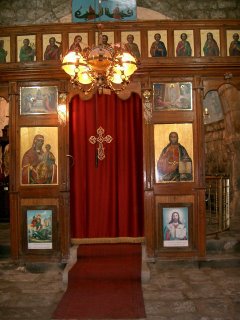 Detail iconostasis, Church of St. George, Izra'a
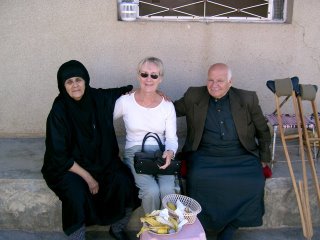 Abu & Um Yusuf
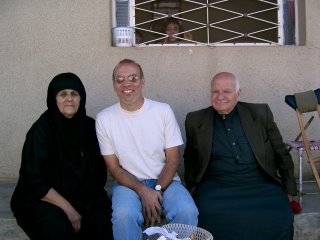 Robert with Abu & Um Yusuf

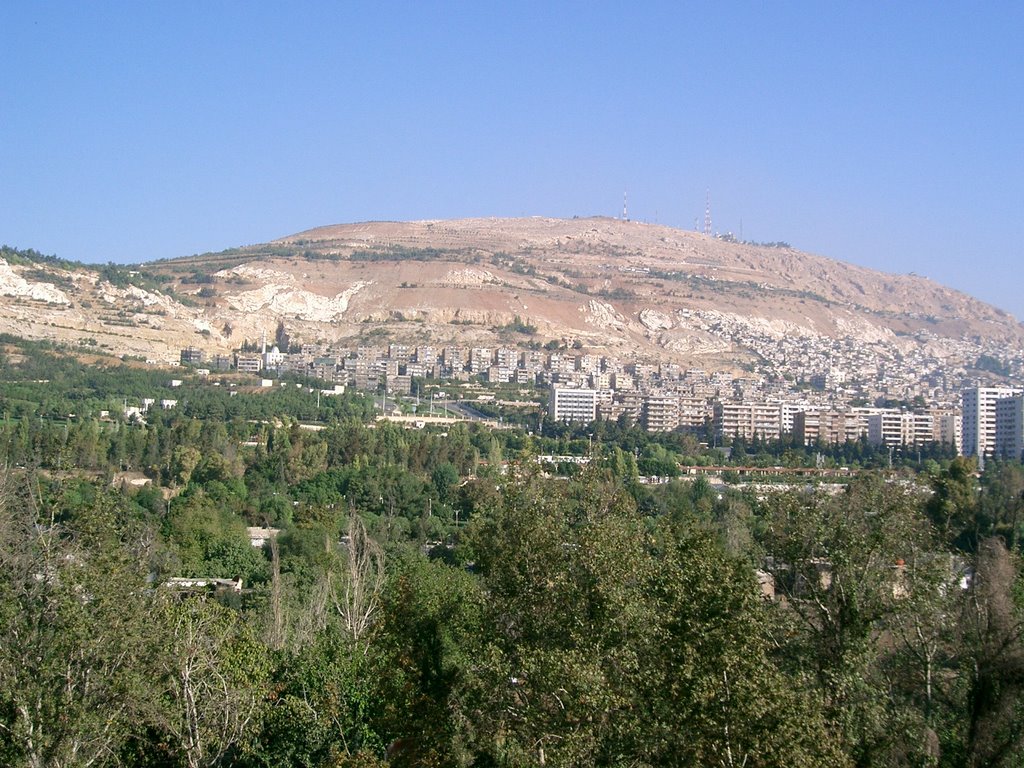 is furnished with the overstuffed seats beloved, it would appear, in all Middle Eastern and Arab countries. So two burgundy chaise longues and several chairs provide the wholly uncomfortable seating. Opposite the house is a patch of spare ground with rubbish containers. The denizens of the district are mostly conservative and the most attractive feature of the place are the cats who have become used to being fed from time to time. The cats in Damascus are not the lean-faced Egyptian variety but have round faces recalling the conformation of Persian cats. With the start of Eid the cats' existence was to find a new menace. The most popular Eid gift for boys this year seems to be a laser gun (In previous years I recall air guns and guns with powder crackers being all the rage) and the cats were the chosen target for persecution. The other saving grace is the view from the sitting-room window which faces in the opposite direction (east) and provides an open aspect of Mount Qassioun and the presidential palace.

